SplashSplat: Reconstructing Splashing Liquids from Real-World Multi-View Videos

Peiyu Liu1*, Dingxi Zhang2*, Federico Tombari3, Marc Pollefeys2,4, Christina Tsalicoglou3, Daniel Barath2,3

1EPFL    2ETH Zurich    3Google    4Microsoft

*Equal contribution

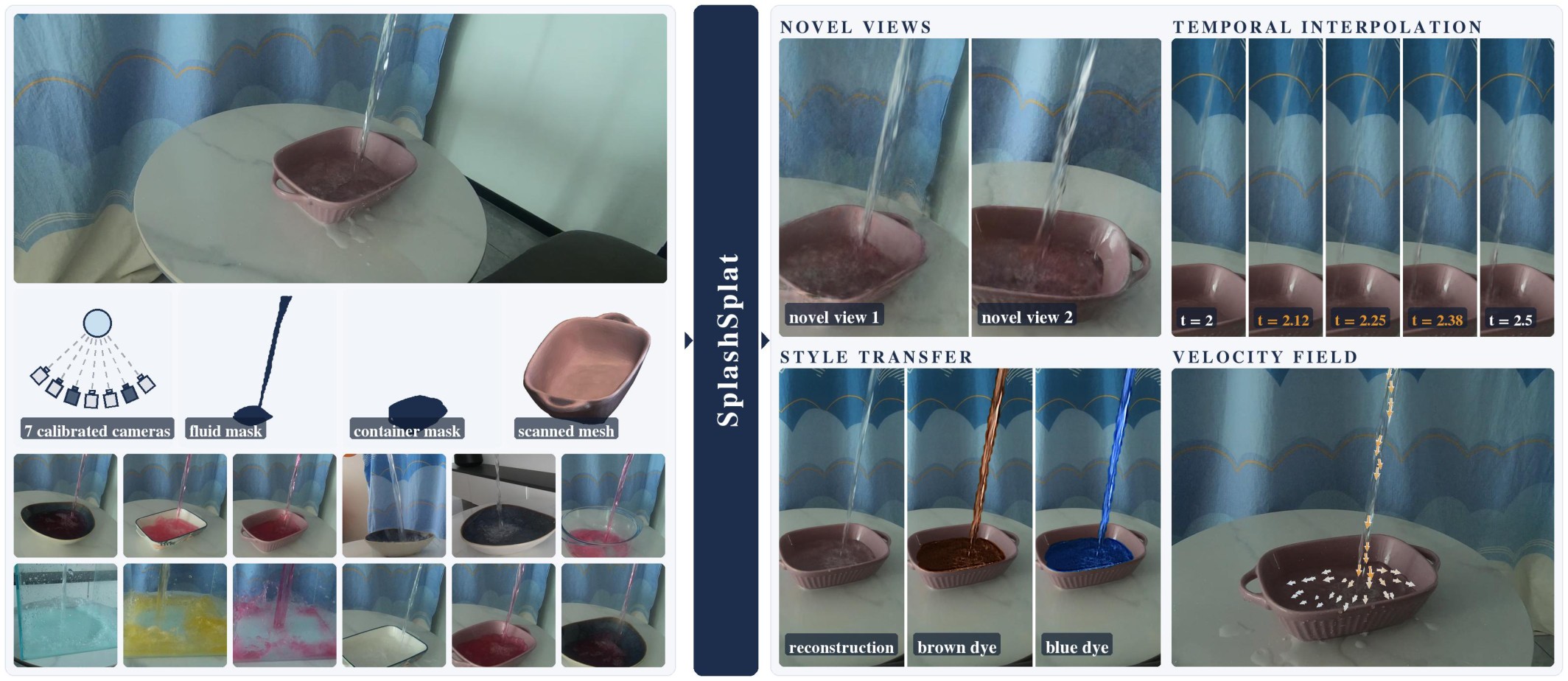
Left: the SplashSplat benchmark, seven calibrated cameras, fluid and container masks, scanned container meshes and a grid of scenes. Right: novel views, temporal interpolation, style transfer and a recovered velocity field produced by SplashSplat.
Left: our benchmark captures pouring and splashing across diverse containers, liquids and backgrounds with seven calibrated cameras, with fluid and container masks and scanned container meshes. Right: from these observations SplashSplat synthesizes novel views, recovers a velocity field, and supports temporal interpolation and style transfer.

Abstract

SplashSplat is a benchmark of 20 real splashing-liquid scenes captured by seven synchronized, calibrated 4K cameras with manually refined liquid masks, and a reconstruction method built on a single principle: impose physical structure only where the observations can constrain it. Per-frame liquid SDFs fused from the masks provide the geometry, level-set transport between consecutive SDFs yields a coarse velocity field, and Lagrangian carriers advected along this flow, corrected against each new observation and reseeded where coverage is lost, decode local Gaussians for differentiable rendering. SplashSplat outperforms state-of-the-art dynamic Gaussian splatting methods on our real captures and on a synthetic benchmark, with physically more plausible motion and a lower training cost, and the same representation supports temporal interpolation and style transfer without re-optimization.

The SplashSplat benchmark

Twenty real scenes of liquid being poured into bowls and tanks, recorded by a seven-camera 4K rig with manually refined per-view liquid masks. The video sweeps from the captured frames to their masks.

Method overview
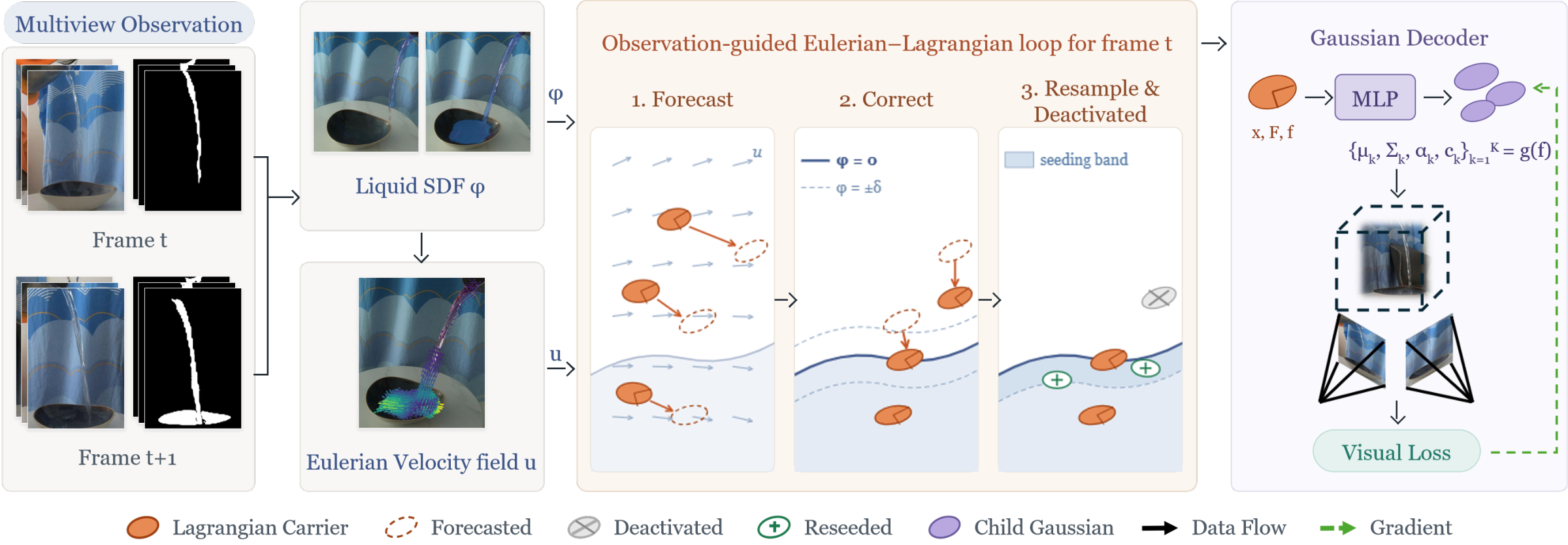
Pipeline: multi-view masks of frames t and t+1 are fused into a liquid SDF and an Eulerian velocity field; an observation-guided loop forecasts Lagrangian carriers along the flow, corrects them against the SDF and resamples the seeding band; a Gaussian decoder turns each carrier into child Gaussians that are rendered and trained with a visual loss.
At each frame, per-view liquid masks are fused into an observed liquid SDF, and consecutive SDFs yield a coarse Eulerian velocity field. Lagrangian carriers move through a forecast–correct–resample loop: they are propagated by the flow, corrected against the next-frame SDF so that drift outside the liquid is suppressed, and resampled where surface coverage is lost. Each carrier decodes local Gaussians, which are rasterized together with a frozen background and optimized under photometric and mask supervision.

Novel-view synthesis on real captures

Temporal interpolation

Style transfer

Citation

@misc{liu2026splashsplatreconstructingsplashingliquids,
      title={SplashSplat: Reconstructing Splashing Liquids from Real-World Multi-View Videos},
      author={Peiyu Liu and Dingxi Zhang and Federico Tombari and Marc Pollefeys and Christina Tsalicoglou and Daniel Barath},
      year={2026},
      eprint={2609.20818},
      archivePrefix={arXiv},
      primaryClass={cs.CV},
      url={https://arxiv.org/abs/2609.20818},
}